
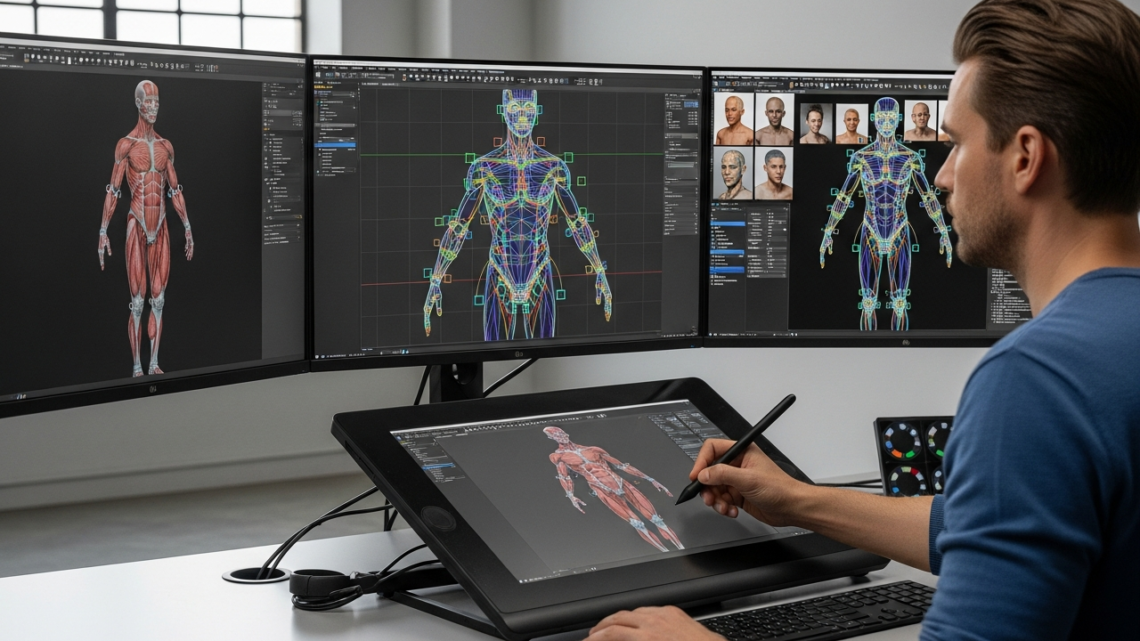
Canada’s game industry generated over $5.5 billion in revenue in 2023, with major studios across Montreal, Vancouver, and Toronto actively seeking skilled rigging artists to power their AAA and indie productions. In this competitive landscape, rigging specialists serve as the crucial bridge between character art and animation, creating the skeletal frameworks that bring digital characters to life through sophisticated deformation systems and control structures.
This comprehensive guide delivers actionable strategies to build a rigging portfolio that stands out to Canadian recruiters, going beyond generic advice to address specific pipeline requirements, bilingual project needs in Quebec, and the technical standards that define success in Canada’s thriving game development ecosystem. You’ll discover how to showcase advanced deformation techniques, optimize for Unreal Engine 5 and Unity pipelines, and leverage Canada’s unique tax credit advantages in your portfolio presentation.
Understand Canadian Studio Expectations for Rigging Artists
Canadian game development hubs each maintain distinct pipeline preferences and cultural requirements that directly impact rigging portfolio expectations. Montreal’s francophone studios like Ubisoft often require bilingual French-English capabilities for collaborative projects, while Vancouver’s EA and other AAA studios prioritize seamless integration with established Unreal Engine 5 workflows. Toronto’s diverse indie scene values versatility and rapid iteration capabilities across multiple engines and art styles.
The technical landscape across Canadian studios heavily favors Unreal Engine 5’s advanced skeletal mesh systems, with Unity maintaining strong presence in mobile and VR-focused productions. Proprietary engines still dominate at major studios, requiring rigging artists to demonstrate adaptability in export workflows and constraint systems. Pipeline standards typically emphasize real-time performance optimization, with Canadian AAA productions demanding sub-20ms frame budgets for complex character rigs.
Understanding the cultural fit between indie flexibility and AAA compliance becomes crucial for portfolio positioning. Canadian recruiters consistently seek evidence of both technical precision and creative problem-solving, reflecting the industry’s balance between artistic ambition and commercial viability.
Quality assurance standards in Canadian studios often exceed international benchmarks due to government funding requirements and tax credit compliance protocols. This elevated standard means portfolios must demonstrate not just technical competency, but also documentation practices and version control awareness that align with studio accountability requirements.
Key Technical Skills Demanded by Canadian Recruiters
Technical proficiency expectations for rigging positions in Canadian studios reflect the industry’s emphasis on both innovation and production efficiency. Recruiters consistently prioritize candidates who can demonstrate mastery across multiple technical domains while maintaining production-ready standards.
- FK/IK blending systems with seamless switching capabilities for animator workflow optimization
- Corrective blendshapes and pose-space deformation for realistic muscle and skin behavior
- Motion capture retargeting and cleanup workflows for performance capture productions
- Real-time facial rigging with FACS-compliant control systems for AAA character work
- Advanced constraint systems including space switching and dynamic parent functionality
- Python scripting for Maya and custom tool development to streamline repetitive tasks
- Cross-platform export optimization for Unreal Engine, Unity, and proprietary game engines
Cultural Fit: From Indie to AAA Pipelines
The cultural divide between indie and AAA development in Canada creates unique portfolio requirements that successful rigging artists must navigate strategically. Indie studios value rapid prototyping abilities, creative problem-solving with limited resources, and the flexibility to wear multiple technical hats throughout production cycles. These environments reward rigging artists who can deliver functional, lightweight solutions quickly while maintaining artistic vision.
AAA production pipelines demand rigorous compliance with established workflows, extensive documentation practices, and the ability to work within highly specialized team structures. Canadian AAA studios expect rigging artists to demonstrate understanding of enterprise-level version control, automated testing procedures, and the discipline to maintain consistency across large character libraries. The scale and complexity of these productions require portfolio evidence of systematic approach to technical challenges and collaborative workflow integration.
Essential Rig Types for Your Portfolio
Strategic rig selection for Canadian studio portfolios requires understanding the specific production demands and genre preferences that dominate the local market. Canadian studios produce everything from mobile puzzle games to AAA open-world adventures, creating diverse rigging requirements that portfolios must address systematically.
| Rig Type | Why Canadian Studios Want It | Example Software/Technique |
|---|---|---|
| Humanoid Game Character | Core requirement for AAA productions, tax credit project compliance | Maya Advanced Skeleton, Unreal Engine 5 Control Rig |
| Creature/Monster Rig | Fantasy RPGs dominate Canadian AAA scene, unique anatomy challenges | Maya custom bone chains, procedural spine systems |
| Facial Animation System | Narrative-driven games require high-quality facial performance | FACS blendshapes, jaw automation, eye tracking |
| Vehicle/Mechanical Rig | Racing games and mech-based titles popular in Canadian market | Constraint-based wheel systems, hydraulic animations |
| Prop/Weapon Rig | Action games require interactive object systems | Parent constraint switching, modular attachment systems |
| Crowd/Background Character | Open-world games need efficient population systems | Simplified control sets, LOD-based rig switching |
| Mobile-Optimized Character | Growing mobile game sector requires performance-conscious rigging | Reduced bone counts, Unity Mechanim optimization |
Prioritizing Rigs by Studio Type
Understanding demand hierarchy helps focus portfolio development efforts on the rig types that generate the most interview opportunities across Canadian studios. Market analysis of job postings and portfolio requirements reveals clear preferences that align with the country’s production strengths and genre specializations.
- AAA Humanoid Characters – Essential for major studio consideration, demonstrates technical foundation
- Creature/Monster Rigs – High demand due to fantasy RPG dominance in Canadian AAA productions
- Facial Animation Systems – Narrative focus in Canadian games creates consistent demand
- Vehicle/Mechanical Rigs – Specialized skill that differentiates candidates for racing and sci-fi projects
- Mobile-Optimized Characters – Growing importance as Canadian studios expand into mobile markets
- Crowd/Background Systems – Valuable for open-world specialists but lower portfolio priority
Craft a Killer Demo Reel Structure
Effective rigging demo reels for Canadian studios must balance technical demonstration with production context, typically maintaining 1-2 minute durations to respect recruiter time constraints while providing sufficient depth for technical assessment. The opening 15 seconds should immediately showcase your strongest technical achievement, followed by systematic coverage of rig functionality through clear, well-lit breakdown shots that demonstrate control responsiveness and deformation quality.
Wireframe overlay views become crucial for technical credibility, allowing recruiters to assess topology flow and edge loop distribution that supports clean deformation. Canadian studios particularly value seeing constraint visualization and control curve displays that reveal the underlying technical architecture. These technical views should alternate with final rendered shots to maintain visual appeal while providing necessary technical validation.
The Canadian twist involves strategic bilingual annotation for Quebec-focused applications, with French technical terminology demonstrating cultural competency for Montreal studios. However, this approach requires authentic language skills rather than superficial translation, as technical accuracy in both languages becomes essential for credibility. English remains the primary language for most technical documentation, with selective French integration showing cultural awareness.
Breakdown shots should progress logically from basic joint rotation through complex deformation scenarios, building confidence in your technical capabilities while maintaining narrative flow. The conclusion should feature your most impressive real-time performance, ideally within game engine context to demonstrate production-ready integration skills that Canadian studios prioritize.
Audio design deserves careful consideration, with subtle technical music supporting rather than distracting from visual content. Many successful rigging reels use minimal or no audio, allowing the visual demonstration to speak for itself while avoiding potential cultural or stylistic missteps that could detract from technical assessment.
Shot Breakdown Best Practices
| Shot Type | Duration | Key Highlight | Common Mistakes |
|---|---|---|---|
| Hero Shot Opening | 10-15 seconds | Most impressive rig in polished lighting | Using unfinished or poorly lit models |
| Control Demonstration | 20-30 seconds | UI interaction showing control responsiveness | Moving controls too quickly to assess |
| Wireframe Technical | 15-20 seconds | Mesh deformation and constraint visualization | Cluttered wireframe displays obscuring detail |
| Stress Test Sequence | 15-25 seconds | Extreme poses showing deformation limits | Breaking the rig or showing failed poses |
| Game Engine Integration | 20-30 seconds | Real-time performance in Unreal or Unity | Poor frame rates or export artifacts |
Technical Reel vs Creative Reel
The distinction between technical and creative rigging reels becomes crucial when targeting specific Canadian studio types, with technical reels serving AAA productions that prioritize systematic workflow integration, while creative reels appeal to indie studios seeking innovative problem-solving approaches. Technical reels emphasize constraint systems, automated solutions, and pipeline integration, using neutral lighting and systematic camera movements that facilitate technical assessment over artistic impression.
Creative rigging reels integrate artistic context and storytelling elements, showcasing how technical systems support creative vision through dynamic character performances and atmospheric presentation. These reels work particularly well for narrative-focused studios and indie developers who value versatility and artistic sensibility alongside technical competency, though they risk obscuring technical details that recruiters need to assess fundamental skills.
Software and Pipeline Mastery
Maya remains the dominant rigging platform across Canadian studios, with over 80% of AAA productions standardizing on Autodesk’s ecosystem for character development workflows. Demonstrating advanced Maya rigging capabilities including custom constraint systems, Python scripting proficiency, and seamless integration with studio pipeline tools becomes essential for serious consideration at major Canadian developers.
Unreal Engine 5 export proficiency has become increasingly critical as Canadian studios adopt Epic’s latest toolset for real-time rendering and virtual production workflows. Portfolio demonstrations should include Control Rig integration, Blueprint connectivity for gameplay systems, and optimization techniques that maintain performance targets across target platforms. Unity export capabilities remain valuable for mobile and VR-focused studios, particularly those developing for emerging markets where Canadian studios maintain competitive advantages.
- Master Maya’s Advanced Skeleton plugin and demonstrate custom script integration for automated rigging workflows
- Showcase Unreal Engine 5 Control Rig systems with real-time constraint solving and Blueprint integration
- Demonstrate Unity Mechanim optimization techniques including avatar configuration and animation controller setup
- Display Python scripting capabilities for custom tool development and pipeline automation solutions
- Show proficiency with industry-standard version control systems like Perforce and Git for collaborative development
- Document experience with studio pipeline tools including Shotgun, Ftrack, and custom asset management systems
- Evidence motion capture workflow integration including retargeting, cleanup, and real-time streaming capabilities
Proven Workflow Tools Comparison
| Tool | Strength for Canadian Pipelines | Integration Notes |
|---|---|---|
| Maya + Advanced Skeleton | Industry standard, extensive plugin ecosystem | Seamless studio pipeline integration, Python extensibility |
| Blender Rigify | Cost-effective for indie studios, rapid iteration | Export challenges with proprietary engines |
| Houdini Character FX | Procedural workflows for complex creature work | Specialized use, requires additional Maya export step |
| Unreal Control Rig | Real-time iteration, native engine integration | Blueprint knowledge required, limited to Unreal projects |
| 3ds Max CAT | Legacy support for established pipelines | Declining adoption, limited to specific studios |
| Unity Animation Rigging | Mobile optimization, real-time constraint solving | C# scripting for advanced features |
Showcase Deformation and Skinning Excellence
Advanced deformation quality separates professional rigging portfolios from amateur demonstrations, with Canadian AAA studios maintaining particularly high standards for character presentation that reflects the country’s reputation for visual excellence in entertainment media. Stress testing scenarios should demonstrate rig stability under extreme conditions while maintaining believable organic deformation that supports animator confidence during production workflows.
Corrective blendshapes become essential for portfolio credibility, addressing common deformation challenges like shoulder candy-wrapper effects, elbow and knee pinching, and facial expression combinations that create unnatural mesh distortions. Canadian studios expect to see systematic approaches to these problems rather than ad-hoc solutions, with clear documentation of the technical methods used to achieve clean results.
Muscle simulation integration adds significant value for character-focused portfolios, though implementation quality matters more than complexity. Simple, effective muscle systems that enhance believability without sacrificing performance often impress recruiters more than overengineered solutions that create workflow bottlenecks. The key lies in demonstrating understanding of anatomical accuracy balanced with production practicality.
Performance optimization for skinning systems directly impacts portfolio success, as Canadian studios operate under strict technical constraints that require efficient solutions. Demonstrating awareness of influence limits, vertex count optimization, and LOD strategies shows production readiness that many portfolios lack. Technical breakdowns should clearly communicate the methods used to achieve high-quality results within realistic performance budgets that support gameplay requirements.
Advanced Skinning Techniques to Demonstrate
Systematic presentation of advanced skinning capabilities requires strategic ordering that builds technical confidence while demonstrating practical problem-solving abilities. These techniques should be presented with clear before-and-after comparisons that highlight the specific improvements achieved through each method.
- Heat map weight distribution analysis showing scientific approach to initial skinning assignment and optimization
- Multi-layered influence mapping with primary and secondary deformation systems for complex anatomical regions
- Corrective pose-space deformation targeting specific problematic joint combinations with automated activation
- Dynamic muscle simulation integration that enhances organic character believability without performance penalties
- Advanced smoothing algorithms and influence blending techniques for seamless deformation transitions between body regions
- Real-time LOD switching systems that maintain visual quality while optimizing performance for gameplay scenarios
- Cross-platform optimization strategies ensuring consistent deformation quality across PC, console, and mobile targets
Benchmark Against Studio Standards
Understanding specific Canadian studio quality benchmarks provides crucial context for portfolio development, with companies like Behaviour Interactive establishing measurable standards for character deformation that reflect both artistic ambition and technical constraints. Behaviour’s rigorous quality assurance protocols require character rigs to maintain visual consistency across multiple lighting conditions and camera distances, creating specific technical requirements that portfolios should address systematically.
Klei Entertainment’s distinctive art style creates unique deformation challenges that require creative technical solutions, with their stylized approach demanding rig flexibility that supports exaggerated animation while maintaining visual coherence. Studying their published materials and developer presentations reveals specific approaches to constraint systems and control design that resonate with their production methodology, providing valuable insights for portfolio positioning.
Major studios like Ubisoft Montreal and EA Vancouver maintain internal quality standards that often exceed industry averages due to franchise requirements and international market expectations. These standards typically include specific performance metrics, visual quality thresholds, and technical documentation requirements that serious rigging candidates should understand and demonstrate capability to meet through portfolio presentation and technical discussion during interview processes.
Portfolio Presentation and ArtStation Optimization
| Platform | Pros for Canadian Recruiters | Cons | Optimization Tips |
|---|---|---|---|
| ArtStation | Industry standard, excellent video hosting, discovery tools | Limited customization, algorithm dependency | Regular posting schedule, Canadian location tags, technical breakdowns |
| Personal Website | Complete control, professional impression, detailed documentation | Lower discoverability, maintenance overhead | Mobile responsive design, fast loading videos, clear navigation |
| LinkedIn Portfolio | Professional networking integration, recruiter accessibility | Limited technical presentation, corporate focus | Canadian game industry connections, skill endorsements |
| Vimeo | High-quality video compression, password protection options | Paid features for quality, limited game industry presence | Professional account for uncompressed uploads, detailed descriptions |
Metadata and Tagging for Visibility
Strategic keyword optimization for Canadian game industry discoverability requires understanding recruiter search patterns and regional terminology preferences. Canadian studios often search using specific technical combinations that reflect their pipeline requirements and project needs, making targeted keyword selection crucial for portfolio visibility.
- Location-specific tags like “Unreal rigging Montreal” and “Maya character artist Vancouver” to target regional opportunities
- Technical skill combinations such as “FK IK blending Maya” and “corrective blendshapes character rigging” for specialized searches
- Engine-specific optimization including “Unity animation rigging” and “Unreal Control Rig portfolio” for platform-focused roles
- Production-focused keywords like “AAA character rigging” and “game production pipeline” to attract established studios
- Bilingual tags incorporating French technical terms for Quebec market penetration and cultural relevance
- Industry project types including “mobile game rigging” and “indie character animation” for diverse opportunity capture
Tailor for Specific Canadian Studios and Hubs
Successful portfolio customization for Canadian studios requires deep understanding of each company’s technical preferences, artistic direction, and cultural values that influence hiring decisions. Ubisoft Montreal’s massive scale and franchise diversity demands rigging artists who can work within established systems while contributing innovative solutions for new intellectual properties, requiring portfolios that demonstrate both technical precision and creative adaptability within AAA production constraints.
EA Vancouver’s sports and racing game focus creates specific rigging requirements around realistic human anatomy and vehicle systems that differ significantly from fantasy-focused studios. Their production cycles and franchise requirements emphasize efficiency and consistency, making technical documentation and systematic workflow demonstration particularly valuable for portfolio positioning with their recruitment team.
Toronto’s indie scene values versatility and rapid iteration capabilities above specialization, with studios like Klei Entertainment seeking rigging artists who can contribute across multiple projects and art styles while maintaining high quality standards. This environment rewards portfolio breadth and evidence of adaptability rather than deep specialization in single techniques or production types.
The cultural differences between Canadian hubs influence portfolio presentation strategies, with Montreal’s francophone environment requiring sensitivity to language and cultural nuance, while Vancouver’s international workforce appreciates technical precision and clear communication. Understanding these regional preferences helps tailor portfolio content and presentation style to maximize resonance with local recruiting practices and studio cultures.
Studio-Specific Portfolio Adjustments
| Studio/Hub | Rig Focus | Pipeline Notes | Application Tip |
|---|---|---|---|
| Ubisoft Montreal | AAA humanoids, creatures, facial systems | Proprietary tools, Anvil engine optimization | Demonstrate scale capability, French language advantage |
| EA Vancouver | Sports characters, realistic anatomy, vehicles | Frostbite engine, mocap-heavy workflows | Emphasize technical precision, realistic deformation |
| Klei Entertainment | Stylized characters, 2D-3D hybrid | Unity-focused, custom animation tools | Show artistic flexibility, indie sensibility |
| Behaviour Interactive | Horror characters, atmospheric rigging | Unreal Engine 4/5, real-time constraints | Demonstrate dark atmosphere comfort, performance focus |
| Gameloft Toronto | Mobile-optimized rigs, casual game characters | Unity mobile pipeline, performance constraints | Emphasize efficiency, mobile platform knowledge |
| Digital Extremes | Sci-fi characters, complex mechanical rigs | Evolution engine, live service requirements | Show mechanical rigging skills, update capability |
| BioWare Edmonton | RPG characters, extensive facial systems | Unreal Engine, narrative-focused tools | Highlight storytelling support, character depth |
Leveraging Canadian Tax Credits in Pitches
Understanding Canada’s digital media tax credit advantages provides strategic positioning opportunities for rigging artists, particularly those eligible for remote work arrangements or willing to relocate within Canadian jurisdictions. Provincial incentive programs in Quebec, Ontario, and British Columbia create cost advantages for studios hiring Canadian residents, making citizenship or permanent residency status a significant competitive advantage that should be prominently featured in portfolio presentations.
Remote work eligibility combined with Canadian tax credit benefits creates unique value propositions for studios considering distributed team structures, especially when demonstrating technical capabilities that support collaborative workflows across multiple time zones. Portfolio presentations should subtly emphasize these practical advantages alongside technical skills, positioning Canadian artists as cost-effective solutions for studios seeking to maximize government incentive benefits while accessing high-quality talent pools.
Common Mistakes and How to Avoid Them
- Prioritizing overly stylized character designs over technical demonstration – Canadian studios need evidence of systematic problem-solving rather than artistic impression alone
- Providing insufficient technical breakdowns that leave recruiters unable to assess underlying technical competency and workflow understanding
- Ignoring motion capture integration requirements that are essential for AAA production pipelines across major Canadian studios
- Focusing exclusively on Maya without demonstrating game engine integration skills that are crucial for modern production workflows
- Presenting rigs with poor performance optimization that would fail to meet frame rate requirements in actual production environments
- Neglecting bilingual capabilities or cultural sensitivity when targeting Quebec-based studios with specific language requirements
- Submitting portfolios without clear project context or production constraints that help recruiters understand practical application scenarios
- Using outdated software versions or techniques that don’t reflect current industry standards and technological capabilities expected by Canadian studios
Quick Fix Checklist
| Mistake | Impact on Canadian Hires | Fix |
|---|---|---|
| No Game Engine Integration | Eliminates consideration for real-time positions | Add Unreal/Unity export demonstrations with performance metrics |
| Poor Video Quality | Suggests lack of technical attention to detail | Upgrade recording software, use professional compression settings |
| Missing Technical Breakdowns | Recruiters cannot assess actual competency level | Include wireframe views, constraint visualizations, control explanations |
| Outdated Software Versions | Indicates resistance to industry evolution | Update to current Maya/Unreal versions, highlight version awareness |
| Generic Portfolio Presentation | Fails to show understanding of Canadian market | Research target studios, customize content and terminology |